Wyatt Earp_The Life Behind the Legend by Casey Tefertiller
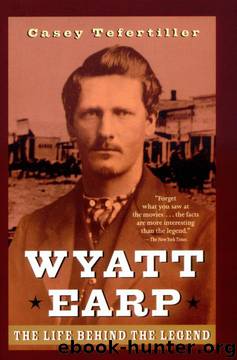
Author:Casey Tefertiller [Tefertiller, Casey]
Language: eng
Format: epub
Published: 2009-01-11T14:58:00+00:00
HAD JIM HUME NEVER LIVED IN THE WEST, the Westerns would have had to create him. Hume perfectly fit the image of a frontier hero: smart, brave, canny, and building a glorious reputation. As Wells, Fargo's chief special officer he had spent more than a decade running down stage robbers in California and Nevada, and usually received the proper degree of respect from the press for his achievements. Wells, Fargo was not amused when its No.1 hero was held up to ridicule.
Hume was two weeks shy of his 55th birthday on January 7, 1882, when he settled down for a pleasant little Sunday-night stage ride from Benson to Tombstone along with eight other passengers and the driver, Jack Sheldon. Stage robberies had become commonplace in Cochise County, and only a few hours earlier $6,500 had been stolen from another stagecoach. But this stage carried no Wells, Fargo box, and no shotgun messenger sat next to the driver.
As the stage rolled on between Contention and Tombstone at about one o'clock Sunday morning, two men stepped out of the shadows and ordered the driver to halt and get off the stage. The robbers passed among the passengers, taking about $1,500. Most notably, they took two fancy pistols and $75 from Hume, a serious humiliation for the man in charge of keeping stage robbers away from Wells, Fargo treasure.
Hume visited the Epitaph office to detail the holdup and said he and most of the other passengers had fallen asleep when the stage pulled to a stop. "Before he was sufficiently awakened to take in the situation the driver was holding the leaders and the outside passenger was standing near the wheelers," the Epitaph story said. The shapes of the driver and passenger in the moonlight made it appear they belonged to the robber party, leading to the conclusion that there were four in on the heist instead of two, according to Hume's story in the Epitaph. "One of the robbers held a shotgun at the window on the inside passengers and forbade any one of them to stir on pain of instant death. Mr. Hume says that to attempt to use his revolvers under the circumstances-and being under the impression there were four robbers-would inevitably involve a sacrifice of the lives of several of the passengers, and as there was none of his employers' treasure on board, he considered he would be acting the part of wisdom to refrain from violent measures."
The bandits, disguised with black cloth masks, were disappointed at the absence of a treasure box, then proceeded to quickly fleece the passengers, missing a good deal of the money. The Epitaph said the robbers "though firm in their demands, were polite in their language and were evidently no novices at the busi- ness."33
Wells, Fargo took the unusual measure of offering a $300 reward, although none of its funds had been stolen. The mighty express company did not like the idea of having its top star disgraced, and it could not have
Download
This site does not store any files on its server. We only index and link to content provided by other sites. Please contact the content providers to delete copyright contents if any and email us, we'll remove relevant links or contents immediately.
| Africa | Americas |
| Arctic & Antarctica | Asia |
| Australia & Oceania | Europe |
| Middle East | Russia |
| United States | World |
| Ancient Civilizations | Military |
| Historical Study & Educational Resources |
Cat's cradle by Kurt Vonnegut(15447)
Pimp by Iceberg Slim(14690)
4 3 2 1: A Novel by Paul Auster(12524)
Underground: A Human History of the Worlds Beneath Our Feet by Will Hunt(12150)
The Radium Girls by Kate Moore(12097)
Wiseguy by Nicholas Pileggi(5851)
The Fire Next Time by James Baldwin(5509)
Perfect Rhythm by Jae(5475)
American History Stories, Volume III (Yesterday's Classics) by Pratt Mara L(5342)
Paper Towns by Green John(5253)
Pale Blue Dot by Carl Sagan(5084)
A Higher Loyalty: Truth, Lies, and Leadership by James Comey(5021)
The Doomsday Machine by Daniel Ellsberg(4559)
The Mayflower and the Pilgrims' New World by Nathaniel Philbrick(4546)
Killers of the Flower Moon: The Osage Murders and the Birth of the FBI by David Grann(4490)
The Sympathizer by Viet Thanh Nguyen(4450)
Too Much and Not the Mood by Durga Chew-Bose(4393)
The Borden Murders by Sarah Miller(4390)
Sticky Fingers by Joe Hagan(4258)
